
From Extrusion to Coil: rethinking how insect screen frames are made
The frame nobody thinks about
An insect screen is one of the simplest products in a window factory, and one of the most revealing. Nobody buys a screen for its frame. Yet the frame is where most of the cost, most of the handling and almost all of the waste sit.
In the conventional route, that frame starts as an extruded aluminium profile, delivered in six-metre bars. Before it becomes a finished part it has to be cut to length and then painted. Both steps are taken for granted. Neither of them adds anything the customer can see.
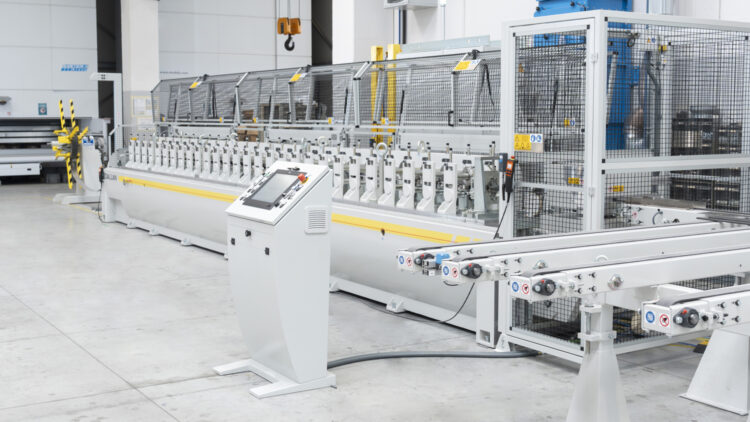
We recently built a line that starts somewhere else entirely: a coil of pre-painted strip. The finished parts come off that line cut to size and already coated. This article is about what happens to the process in between.
What the extrusion route really costs
Extrusion is a mature, excellent process. The problem is not the profile. The problem is everything the bar format forces you to do afterwards.
You cut, and you throw part of it away. A six-metre bar rarely divides evenly into the lengths a window order needs. Whatever is left at the end of the bar is scrap, and it is scrap in an expensive alloy. This is the same arithmetic that roller shutter producers know well: the waste is not a defect, it is built into the starting format.
You paint after you cut. Because the cut exposes bare metal and because colour is chosen per order, coating happens downstream, on parts rather than on material. That means racking, hanging, curing, unracking, and a second quality check on every piece.
You store colour. Each finish is a separate stock keeping unit in bar form, or a separate batch through the paint line. Either way, colour becomes inventory rather than a setting.
You move the part several times. Between the saw, the paint line and assembly, the part is handled, buffered and counted. None of this changes the geometry of the frame.
Starting from coil instead
The line in the video begins with a coil of pre-painted strip. The coating is applied by the steel or aluminium producer, on flat material, before anything is formed. It is continuous, uniform and already paid for in the price of the strip.
From there the sequence is short. The strip is decoiled and fed into the roll forming line. The frame profile is formed progressively through the roll stations. The part is cut at the exact finished length the order calls for. It leaves the line coated, sized and ready for assembly.
Two things follow from this that are easy to miss.
The first is that there is no bar. Length stops being a constraint inherited from the supplier and becomes a parameter in the control system. Cutting to a different length is a number, not a new purchase.
The second is that there is no painting stage after forming. Finish is decided when the coil is loaded, not at the end of the process. Changing colour means changing coil.
What disappears
The interesting number is not the speed of the line. It is the count of steps that are no longer there.
Scrap deserves a closer look, because the arithmetic here is specific. A screen frame for an 800 x 1200 mm window needs pieces of those lengths, and a set of orders rarely adds up to an exact multiple of six metres. Whatever cannot be nested into the last bar is lost. In this application that offcut is typically around 15% of the material, and it is extruded aluminium, which is one of the most expensive ways to buy metal.
Working from coil, the part is cut at its finished length, so that end-of-bar offcut does not exist. What remains is the head and tail of the coil plus the setup pieces, spread across a whole production run instead of repeating on every single bar.
This is worth distinguishing from the more familiar comparison between coil-fed and sheet-fed production. The reference point here is not a sheet. It is a six-metre extruded bar, and the waste comes from the length format rather than from nesting on a flat blank.
The second saving is less visible on a balance sheet and more visible on a shop floor: a whole process stage, with its own space, its own operators, its own queue and its own rework, is simply not there.
A pattern we keep seeing
Insect screens are not an isolated case. Over the last few years we have been asked more and more often to replace an extruded profile with a roll formed one in pre-painted steel or aluminium.
The products vary: roller shutter components, screen and blind frames, window and door trims, furniture and shopfitting profiles, technical sections for the building envelope. The reasoning behind the request is almost always the same.
Material cost per metre is lower, and in aluminium the gap has been uncomfortable for several years. Pre-painted strip removes a finishing operation rather than optimising it. Coil-fed lines cut at finished length, so the bar format and its offcut disappear. And once the profile is produced in line, the step toward automated end-of-line handling and packaging is short.
What has changed is not the economics, which have always favoured coil at volume. What has changed is what roll forming can now produce. Tighter tolerances, more complex sections, in-line punching and laser cutting, and parametric control of length and hole pattern have widened the range of profiles that are realistic candidates. Geometries that were only achievable by extrusion ten years ago are not necessarily so today.
Where the switch works, and where it does not
We would rather say this plainly than oversell it. Extrusion is not going away, and there are products for which it remains the right answer.
The switch tends to work when the section is open or can be closed by a fold or a seam, when wall thickness is reasonably constant, when the part is produced in recurring volumes, and when a coil coating meets the finish requirement. Dedicated lines pay back fastest where the same family of profiles runs regularly.
The switch is harder when the section has very thick or strongly varying walls, when internal chambers and undercuts are structural rather than decorative, when anodising or a specific surface effect is specified, or when annual volume is too low to justify a dedicated line and tooling. Thermal break constructions and heavily structural profiles usually stay with extrusion.
The honest test is not “can roll forming do this profile”. It is “what would this profile look like if it were designed for coil from the start”. The products that convert best are rarely identical copies of the extruded part. They are redesigned slightly, and the redesign is where most of the saving comes from.
The question worth asking
Most manufacturing improvement work goes into doing existing steps faster. The larger gains usually come from a different question: why does this step exist at all.
For screen frames, the saw exists because the material arrives in bars. The paint line exists because the material arrives bare. Change the starting format and both reasons evaporate. The steps are not optimised, they are removed.
So it is worth asking, for your own product: does it really need to start from a bar?
The deo below shows the complete line, from coil to finished frame components. If you want to know whether one of your profiles is a candidate, send us the drawing and the annual volume, and we will tell you honestly whether it is.
Contact us:
Email: : [email protected]
Or use our request form