
Coil-Fed Laser Blanking with Parametric Programming: From Master Program to Stacked Pallets
Cutting large panels from individual sheets generates significant material waste. The contour of the part rarely matches the geometry of a standard sheet, which leaves large unusable cut-offs around every blank. Beyond the scrap rate itself, manufacturers face the operational cost of stocking, handling, and moving oversized sheet metal stacks, with the safety and logistics challenges that come with them.
Coil-fed laser blanking solves both problems at the source: panels are cut directly from a continuous metal coil, and the system unwinds only the exact amount of material needed for each part. At Dallan, we have been refining this approach since 2014 with our LXN line. The new LXN III takes it one step further, combining the proven yield benefits of coil-fed laser blanking with parametric programming software that eliminates the CAD/CAM workflow entirely. This article explains how the system works, why it cuts scrap to single-digit percentages, and how the parametric Master Program approach removes manual programming from your daily production routine.
What is coil-fed laser blanking?
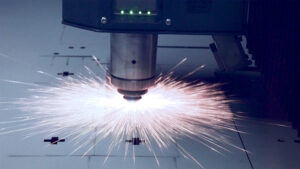
Coil-fed laser blanking is a sheet metal manufacturing process in which a fiber laser cuts finished panels (also called blanks) directly from a continuous metal coil, instead of from pre-cut sheets. The coil is unwound, advanced through the cutting area by motorized rolls, and held in position by a vision-based system that compensates for any feeding deviation in real time. The laser head cuts the part contour while the coil keeps moving in coordination with the cut path. Coil-fed laser blanking is sometimes also called coil-fed laser cutting when the focus is on the cutting operation rather than on the blanking output. Compared to a traditional flatbed laser cutting machine, a coil-fed laser blanking line removes the upstream step of decoiling, leveling, and shearing into individual sheets, and removes the downstream waste of off-cut frames around each part.
The problem with sheet-based panel cutting
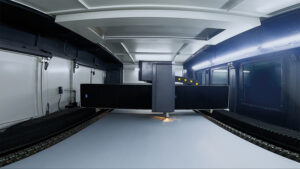
Cutting panels from individual sheets has a structural inefficiency. Standard mills produce sheet sizes optimized for stocking and handling, not for the geometry of any specific part. When you nest your blanks into one of these sheets, the unused area between contours becomes pure scrap. In most door panel applications we have seen, scrap rates exceed 20%. In some cases, like our customer Sukup, the US grain bin manufacturer, scrap rates can reach 60% on the largest panels.
There is also the indirect cost. Large sheet stocks need warehouse space, forklift handling, and overhead crane infrastructure. Every sheet handled is a safety risk and a productivity tax. When part dimensions change frequently, the time spent picking, moving, and re-stocking the right sheet for the right job becomes the real bottleneck.
The LXN III: vision-based coil processing up to 15 meters
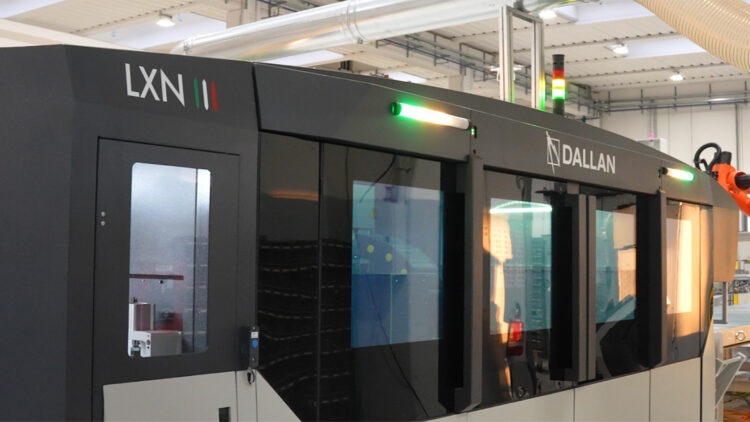
The Dallan LXN III is a coil-fed laser blanking line designed to cut parts up to 15 meters in length directly from coil. The line integrates a fiber laser cutting head with a patented vision system that continuously tracks the coil position and compensates for any feeding misalignment in real time. This is what allows the LXN III to maintain cutting accuracy across very long parts, without the cumulative error that would normally limit coil-fed processing.
In production environments using the LXN III, scrap rates drop below 9%, compared to 20% or more on conventional sheet-based laser cutting. The improvement comes from two factors combined: the system unwinds only the exact length of coil needed for each part, and the parametric programming workflow described below removes the nesting tradeoffs typical of sheet processing. Together, these deliver a measurable improvement in material yield on every shift.
The LXN III also includes a centralized automatic lubrication system, integrated extraction directly at the laser head, and two internal surveillance cameras for production monitoring. For a complete view of the coil laser cutting machine configuration, see the dedicated product page.
Parametric programming: how the Master Program works
Programming a laser cutting machine traditionally requires three steps:
- A CAD operator generates a DXF file of the part geometry.
- A CAM operator prepares the nesting layout and exports an ISO program for the cutting machine.
- The program is sent to the machine and started.
For high-mix production, this CAD/CAM cycle becomes a bottleneck. Every part variant needs a new round of CAD work, nesting, and code generation, even when parts share the same parametric structure.
Dallan ParametriX takes a different approach. If your parts can be described by parametric formulas, and door panels are a typical example where dimensions vary but the geometry follows fixed rules, you can define a single Master Program that captures all the production rules of the part family. The Master Program is built once.
After that, ParametriX reads from a standard Excel, CSV, or XML table the following information:
- Master Program name
- Parameters X1, X2, … that define the specific part to produce, plus any marking data
- Quantity to produce
From this input, the software automatically:
- Generates the DXF file of the part
- Builds the nesting layout
- Generates the cutting program for the laser
- Generates the unloading instructions for the downstream stacking system
No operator intervention. No CAD, no CAM, no ISO programming. Paper work orders disappear from the shop floor, and the entire programming workflow for the coil-fed laser blanking line becomes a data exchange between your production planning system and the machine.
From Excel to finished pallet: the automated workflow
The full workflow with the LXN III and ParametriX runs as follows. Production planning exports a list of parts to produce, with their parametric values, into a CSV or Excel table. ParametriX consumes the table and generates the cutting program, the nesting layout, and the unloading instructions. The line starts cutting; the parts are extracted from the cut coil section by the integrated palletizing cell, which receives part coordinates and stacking position directly from ParametriX.
In operational terms: a single production planner can release work to the laser blanking line directly from a spreadsheet. The CAD/CAM step is gone. The need for a dedicated machine programmer is gone. The cycle from order to finished pallet runs without human handling between input and output.
Beyond cutting: integrated palletizing and downstream profiling
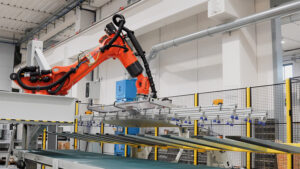
The palletizing system integrated with the LXN III is itself parametric: the gripper automatically adapts its width to the panel being picked, eliminating the need for tooling changes between part formats.
For pre-painted material, which is common in panel production, we have added an automatic flipping function so that panels are immediately oriented for downstream pickup and feeding into the next station, typically a Dallan roll forming line that completes the panel profile in a separated work cell. Pallet transfer between cells can be handled by forklifts or AGVs, depending on the layout and the distances involved.
The palletizing cell, the laser blanking line, and the roll forming line all communicate through ParametriX, which means a single production order propagates through the full process without manual re-entry. For high-mix door panel production, or any panel application where part dimensions follow parametric rules, this is the closest configuration we have seen to truly unattended manufacturing.
Talk to talk about us!
If you are looking to reduce material scrap, simplify your sheet metal production, and remove laser programming from your operators’ workload, the LXN III with ParametriX is built for exactly this. To see the full coil-fed laser blanking line in action, watch the video ⬇️ below or get in touch.
Email: : [email protected]
Or use our request form.